
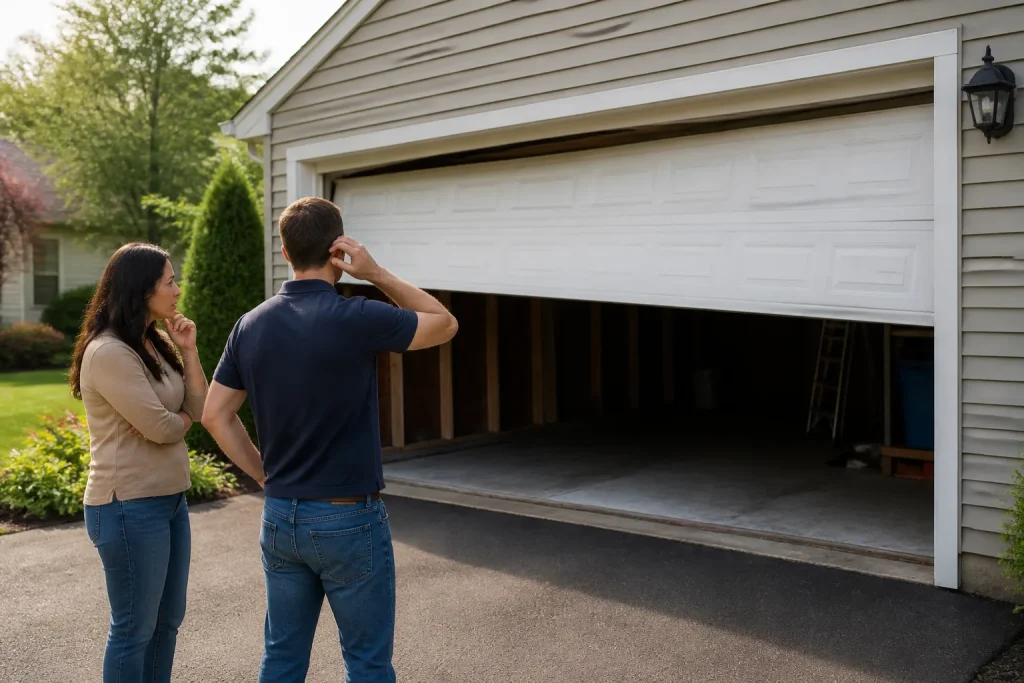
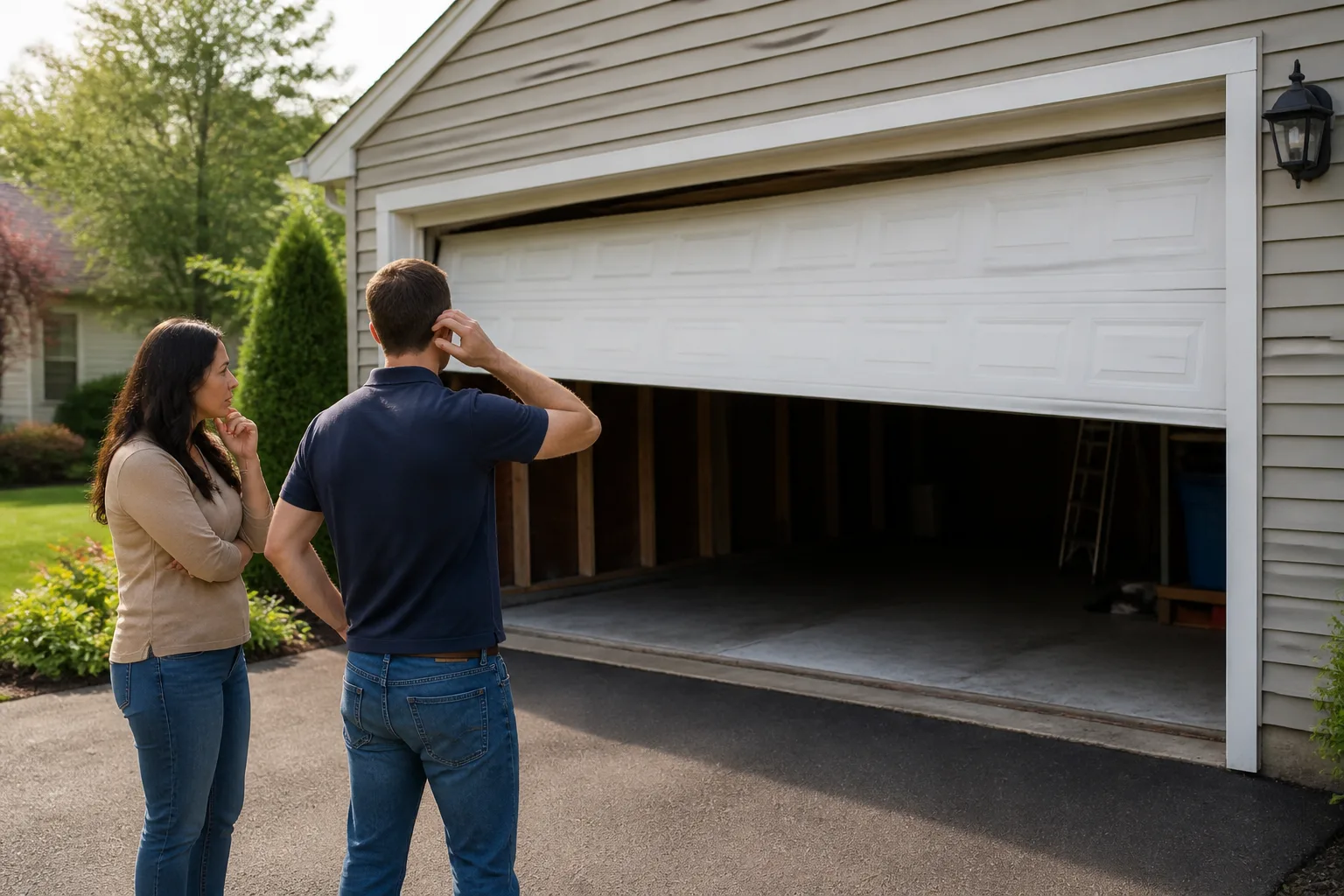
Garage Door Repair: Repair or Replace? How Vineland Homeowners Decide
A ten-year-old Clopay door that’s been repaired twice might have another fifteen years in it. A five-year-old builder-grade steel door with two bent panels and a rusted bottom section can be past the point where repair makes economic sense. Notice what’s missing from both of those examples: the age of the door. In our experience, age is the least useful variable in the repair-or-replace decision. What actually matters is cumulative repair cost, panel integrity, and where the hardware sits on its cycle life. Decide the right way and you’ll either save thousands or stop pouring money into a door that’s already gone. Either way, you need a framework, not a gut feeling.
If you’d rather have a specialist look at it than work through the math alone, call (844) 443-4769. We answer 24/7. Fast dispatch from 7am to 7pm, Sunday through Friday.
What’s the first test: repair or replace?
The first test is cumulative cost, not condition. Add up what you’ve spent repairing the door over the last 24 months. If that number is approaching half the cost of a comparable new door installed, replacement is usually the rational choice, even if the door still works today. This is the 50% rule, and it applies to garage doors better than to almost anything else in a house.
Here’s why. A garage door is a mechanical system with springs, cables, rollers, hinges, and an opener all wearing at once. When one part fails, the others are usually close behind. Once you cross the halfway point in cumulative repair cost, you’re often funding the slow decline of an assembly that’s going to keep asking for money.
Run the math against real Vineland numbers. In our experience, a general repair on a Vineland door typically runs a few hundred dollars, and spring replacement is in the same ballpark per spring. A matched pair of springs is usually replaced together, so budget roughly twice a single-spring price. Two or three repairs inside two years, and you can hit the halfway mark fast. A comparable new door installed is a much larger number, which is exactly why the 50% line is the practical threshold and not a guess.
One caveat: if the door is otherwise structurally sound and the repairs have been spread out across different systems (an opener belt this year, a roller set two years ago), the cumulative cost argument weakens. The 50% rule works best when repairs are clustering on the same system.
Is it a structural problem or a cosmetic one?
Panel integrity is the deciding factor most homeowners get wrong. A dented panel on the bottom row that still sits flat in its section is cosmetic. A bent or buckled top panel changes the picture entirely, because the top section carries the opener’s pull force through the reinforcement strut. When that section is compromised, the door flexes under load, the opener works harder, and the whole assembly becomes a safety concern.
Here’s how to tell which one you’re dealing with:
- Look at the top section under load. With the door closed, watch the top panel as the opener starts to lift. If the panel bows, flexes, or visibly distorts before the door clears the floor, that’s structural, not cosmetic.
- Check the panel seams. Gaps opening between sections, or a panel that’s out of plane with its neighbors, means the section has lost its shape and won’t travel cleanly through the tracks.
- Inspect the bottom section for rust-through. Surface rust is cosmetic. Rust that’s eaten through the steel skin, or a bottom section that’s soft under thumb pressure, is a replacement trigger. This matters in South Jersey, where road salt tracked in on vehicles and wet winters do a number on the bottom of a steel door.
- Test the panels on a Wayne Dalton or Amarr steel door by feeling for flex. Press gently at the center of each panel. A healthy panel feels rigid. A compromised one gives.
If the damage is on a middle panel and the top section is sound, panel replacement is often the smart call. If the top section is the problem, price replacement before you price anything else.
What does an opener’s cycle rating actually tell you?
An opener rated at 10,000 cycles is a 13-year opener for a typical Vineland household running two open-close cycles a day. That number is useful because it tells you whether an opener failure is a repair or a replacement, and most of the time it’s a repair. An opener that’s failed at year 8 of its cycle life is a repair candidate, not a replacement candidate. The gear, the logic board, the travel limits, the safety sensors: any one of those can fail while the rest of the unit has years left.
But the cycle math only applies when the opener is matched to the door. This is where the mismatched-pair trap catches people. Openers are rated for a door weight and a door size. If your door is heavy (a solid wood or an insulated double), and the opener was sized for a lighter door, you’re asking the motor and the gear train to do more work than they were built for. In that case, replacing a failed opener with an identical unit is setting up the next failure.
Where the pairing matters most:
- Same weight, same size, functional opener: replace the door, keep the opener. No reason to pay for hardware that’s still within its cycle life and correctly matched.
- New door is heavier than the old one (often the case when you swap a non-insulated door for an insulated one): the opener’s torque and spring balance may no longer suit the door. A paired replacement is usually the right move, not because the old opener was bad, but because it’s now under-specified.
- Opener has failed and the door is sound: repair the opener. A LiftMaster or Chamberlain logic board or a Genie gear set is a serviceable part, and the rest of the unit has life left in it.
If you’re not sure which column you’re in, our garage door opener repair work includes checking the opener against the actual door load, so you’re not guessing at a spec sheet.
When does insulation justify replacement on its own?
Insulation is a legitimate replacement trigger when the garage shares a wall or a ceiling with living space. If your Vineland home has an attached garage under a bedroom or beside a living room, an uninsulated door is a genuine thermal weak spot, and swapping to an insulated door does real work on heat loss through that wall. If the garage is fully detached or unconditionally separated from the house, insulation is a comfort upgrade, not a thermal necessity.
The R-value question gets oversimplified in most guides. What actually matters is the whole assembly: the door’s insulation, the weatherstripping around the perimeter, and the bottom seal. A well-insulated door with a leaking bottom seal still loses air. So when an insulated door is the goal, price the seal and the threshold at the same time. A door replacement is a good moment to get the perimeter sealed properly.
An insulated door is also heavier, which pushes you back into the opener-pairing conversation above. If the current opener was sized for a light non-insulated door, budget for an opener that matches. That’s not a sales tactic; it’s the difference between getting 13 years out of the new opener and getting 8.
When to call a pro
Some of this you can assess yourself: panel flex, rust-through, visible bowing under load, whether the opener is struggling. Some of it you should not touch. Garage door springs are under high tension, and the cables and bottom brackets are equally dangerous. Adjusting or replacing a spring, cable, or bottom bracket is not a homeowner job, and the failure mode when one lets go is serious injury. If a spring has broken, step back and call a trained professional; nothing about that repair is a learning exercise.
The same goes for opener wiring and the safety-reversing system. If the door doesn’t reverse when it meets an obstruction, stop using it and get it looked at before someone gets hurt. We’ve seen enough doors come off their tracks to know the difference between a nuisance and a hazard.
That’s the reason Vineland homeowners call us for a free, no-pressure assessment: someone with up to 11 years of technician experience walks the door, checks the panels, tracks the spring history, and puts a written estimate in front of you before any work starts. The written estimate sets the final price. There’s no surprise invoice when the job is done.
Related services in Vineland: if you need help deciding, our garage door repair and garage door spring repair pages lay out what each job actually involves. And for a full view of what we do, see Garage Door Repair Vineland.
The Bottom Line
Decide based on three variables, in this order: cumulative repair cost versus half of a comparable replacement, structural panel integrity (especially the top section), and the opener’s cycle life relative to your door’s weight. Age tells you almost nothing. A well-maintained ten-year-old door can be a repair candidate; a damaged five-year-old door can be replacement-ready. The 50% rule, a top-section inspection, and a quick cycle-count check will give you a clear answer in most cases.
If you’re in Vineland and need help, Garage Door Repair Vineland offers free estimates. We handle Clopay, Amarr, Wayne Dalton, Craftsman, and more, and we’ll tell you honestly whether your door is worth fixing. Call (844) 443-4769. We answer 24/7. Fast dispatch from 7am to 7pm, Sunday through Friday.
Frequently Asked Questions
Start with cumulative cost. If you’ve spent close to half the cost of a comparable replacement door over the last two years, replacement is usually the better call. Then check the top panel for flexing under load and the bottom section for rust-through. If both are sound and the opener is matched to the door, repair is almost always the answer. Call (844) 443-4769 for a free assessment if you’re unsure.
Most Vineland repairs run a few hundred dollars, with spring work quoted per spring. A matched pair of springs is usually replaced together, so budget roughly twice a single-spring price. Every job is quoted and agreed before any work starts, so the written estimate sets the final price. Call (844) 443-4769 for an exact quote. Estimates are free.
For urgent repairs, yes, when the schedule allows. Same-day service is part of what we do, and we answer 24/7. A call outside dispatch hours is booked into the next opening, Sunday through Friday, 7am to 7pm. If your door is stuck open or a spring has let go, call and we’ll get you on the schedule. Estimates for planned work like replacement are scheduled after a measure, not done same-day.
No. We quote the job, you approve the quote, and that’s the price. The written estimate is the final number, and the estimate itself is free. If something unexpected turns up during the work, we stop and re-quote before proceeding. Call (844) 443-4769 to book a free estimate.
Written by the team at Garage Door Repair Vineland.
Need Garage Door Help?
Call Garage Door Repair Vineland - the local pro we connect you with is licensed and insured, here with fast help in Vineland.
(844) 443-4769