
Emergency Garage Door Repair Near Me: What Vineland Homeowners Should Do First
A garage door stuck open at 11 PM is an open doorway to your house, and the first thing to do has nothing to do with finding a phone number. It has to do with securing the opening. Engage the manual lock on the door itself, confirm nothing is still moving, and only then start making calls. The 20 minutes between the failure and a technician’s arrival are where most of the avoidable damage and most of the security exposure happen. This guide lives entirely inside that window.
If you’d rather skip the triage and get a specialist on it, call (844) 443-4769. We answer 24/7. Fast dispatch from 7am to 7pm, Sunday through Friday.
Key Takeaways
- Secure the opening first with the manual throw-bolt lock, then call. A door left open overnight is the real emergency.
- Never try to lift or hold a door with a broken torsion spring. That door weighs far more than it looks like it does, and nothing is holding it up.
- Have door width, panel count, and your opener’s model number ready. It’s the difference between a confirmed parts match and a second trip.
- Broken spring under tension, vehicle trapped, home unsecured: those are true emergencies. A noisy opener that still works can usually wait until morning.
How Do I Secure a Garage Door That’s Stuck Open in Vineland?
The manual lock on your door is the fastest way to close off the opening without touching the door’s lifting mechanism at all. Nearly every residential sectional door has a throw-bolt or slide-lock mounted on the inside face of one panel, usually on the center stile. You slide the bolt sideways into the vertical track or the track’s receiving hole. That physically pins the door to its rails. It doesn’t need power, it doesn’t need the opener, and it takes about ninety seconds once you know where to look.
Here’s the sequence we’d walk any Vineland homeowner through:
- Confirm the door isn’t moving. If the opener is still grinding or the door is drifting, pull the opener’s red release cord (more on that below) only after you’re sure the door is fully down or fully up and at rest.
- Locate the manual lock. Look on the inside of the door at roughly waist height on the center stile. If your door has no lock, a pair of locking pliers clamped onto the vertical track just above a roller will hold the door in position as a stopgap.
- Engage the throw bolt into the track on both sides if your door has two locks. One side is better than nothing; two sides is best.
- Block the opening from the outside if the door is fully up. A vehicle parked close to the opening, or a heavy object placed against the inside face, buys time.
- Then call. Once the opening is secured, the urgency shifts from “someone could walk in” to “let’s get this fixed today,” and that’s a much calmer phone call.
One practical note for Vineland: the older housing stock in the city means plenty of doors built before the auto-reverse safety sensors became standard. On those doors the manual lock is often the only positive lock on the whole assembly, so it’s worth finding now, in daylight, before you need it.
What Should You Never Do During a Garage Door Emergency?
Never try to manually lift or hold up a sectional door whose torsion spring has failed. That’s the single most dangerous move a homeowner can make, and the physics explain why. A typical double-car sectional door weighs somewhere in the range of 150 to 200 pounds, and the torsion spring’s entire job is to counterbalance almost all of that weight. When the spring snaps, that counterbalance disappears. What’s left in your hands is the full dead weight of the door, riding on steel rollers in a track, with nothing to stop it from coming down.
We’ve seen what a drop like that does to a wrist, a shoulder, and a door panel. It’s the reason spring work is a specialist job, and the reason our garage door spring repair work is treated as a high-risk mechanical job rather than a quick swap.
Other moves to avoid while you wait in Vineland:
- Don’t keep cycling the opener to “see if it works this time.” Every cycle puts stress on a damaged component and can bend panels or strip the opener’s gears.
- Don’t pull the red release cord on a door that’s currently up. If the trolley is under tension and the door is partially open, releasing it drops the door.
- Don’t try to straighten a bent track by hand or with a pry bar. A loaded track under spring tension can swing back violently.
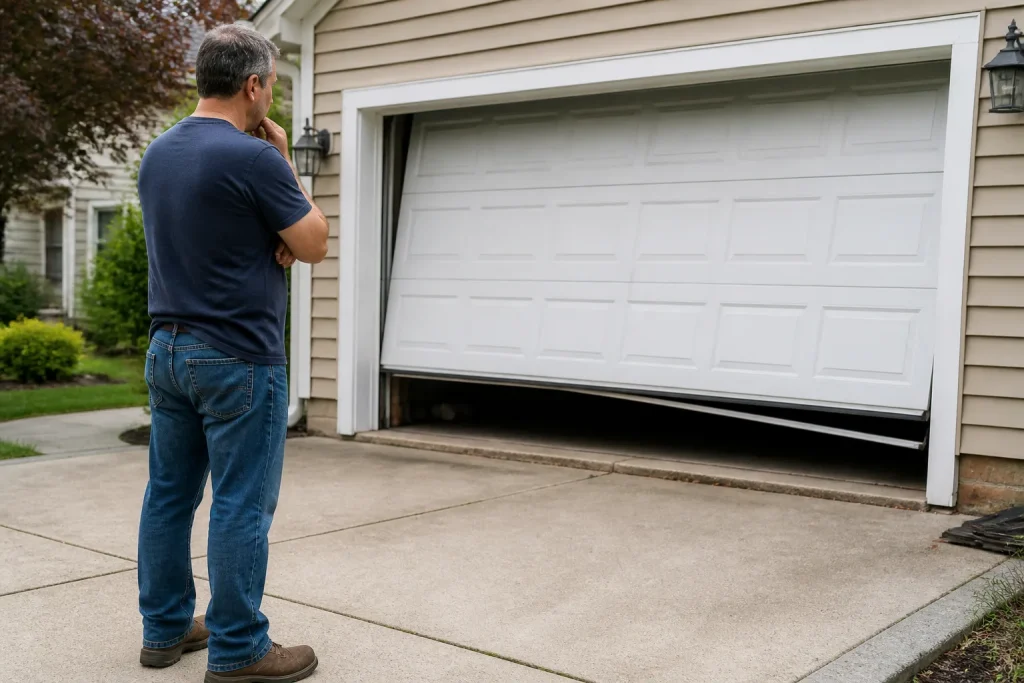
- Don’t stand under a sagging door panel. If a panel is bowing or the cables look slack, keep everyone clear of the opening.
- Don’t cut or loosen a torsion cable to “take the tension off.” Cables are under the same load as the springs and are just as unforgiving.
The safest thing you can do with a broken spring is leave the door exactly where it is, secure the opening, and let a trained specialist handle the counterbalance. That’s a call, not a project.
How Do You Disengage a Jammed Opener Without Damaging the Door?
Disengage a jammed opener by pulling the red emergency release cord once, gently, and only while the door is fully closed. That cord disconnects the trolley carriage from the opener’s rail on the ceiling, which lets you move the door by hand and stops the motor from fighting a jammed mechanism. The key word is “fully closed.” If the door is halfway up and you release the trolley, the door’s weight can drop without warning.
Here’s how the disengage goes when it’s done safely:
- Cut power to the opener at the wall switch or breaker. That eliminates any chance of the motor kicking on mid-procedure.
- Check the door’s position. Fully closed is safe to release. Partially open is not. If the door is up, secure it first (see the throw-bolt section above), then call a technician.
- Pull the red cord straight down and slightly toward the door. One firm, steady pull. Don’t yank.
- Listen for the click of the trolley disengaging from the rail. If there’s no click, stop pulling; you’ll risk bending the carriage arm.
- Test the door by hand with a light lift. It should move freely, if it moves at all. If it fights you, something is jammed in the track and you should leave it alone.
The trolley carriage is a small plastic or metal piece on the rail. Pull it hard or at an angle and it can pop off the rail entirely, which turns a jam into a broken opener. LiftMaster and Chamberlain openers use a similar trolley design, and once that carriage is off, re-seating it is a technician job. Lift the door by the panel stiles, not the top section or the hinges, if you need to move it at all.
What Information Should You Have Ready Before You Call?
Have three things ready before you dial: the door’s width, the number of panels, and your opener’s brand and model number. Those three details let a Vineland technician confirm parts availability against what’s actually likely to be wrong before anyone gets in a vehicle. It’s the difference between a first-visit fix and a “we’ll need to order that” second trip, and on an emergency call the second trip stings.
Where to find each one:
- Door width. A quick tape measure across the opening. Single-car doors run about 8 to 9 feet; double-car doors about 16 feet. Any unusual size is worth flagging.
- Panel count. Count the horizontal sections from the bottom up, typically four or five on a standard residential door. Mention if it’s a carriage-house or full-view door, since the panel hardware differs.
- Opener model. The sticker is on the back or side of the motor housing on the ceiling. Brands like LiftMaster, Chamberlain, Genie, and Craftsman all print a model number there. Snap a photo with your phone and have it ready.
- What the door is doing. “It won’t close,” “it goes up partway and stops,” “there’s a snap and the door won’t lift” – those are different problems, and a technician can tell a lot from a clear description.
- Whether it’s stuck open or closed. This matters for security and for how the technician approaches the door when they arrive.
If you’ve got the photo and the width, and the spring has snapped under tension or the door is open to the street, a locksmith isn’t the answer; a garage door specialist who knows the brands on your door is. We work on Wayne Dalton, Raynor, Clopay, Amarr, and the openers above specifically, so naming your model does real work.
Is It a Real Emergency or Just Urgent?
A true emergency is a security breach (door stuck open, especially overnight), a vehicle trapped inside, or a broken torsion spring still under load. Everything else is urgent but can usually wait until the next normal service window. Getting that distinction right saves you a stressful evening and lets the right job get the right response, since an emergency dispatch should go to a door that actually needs it.
Here’s how we’d sort the common situations in Vineland:
Genuine emergencies (call now)
- Door stuck open. Your home is unsecured. Secure it with the manual lock, then call. We answer 24/7, and a call outside dispatch hours is booked into the next opening, Sunday through Friday, 7am to 7pm.
- Vehicle trapped inside. You can’t get the car out and you need it now. That’s an emergency.
- Broken spring under tension. The door may be stuck mid-travel with a snapped spring and a cable that’s under load. Keep everyone clear and call.
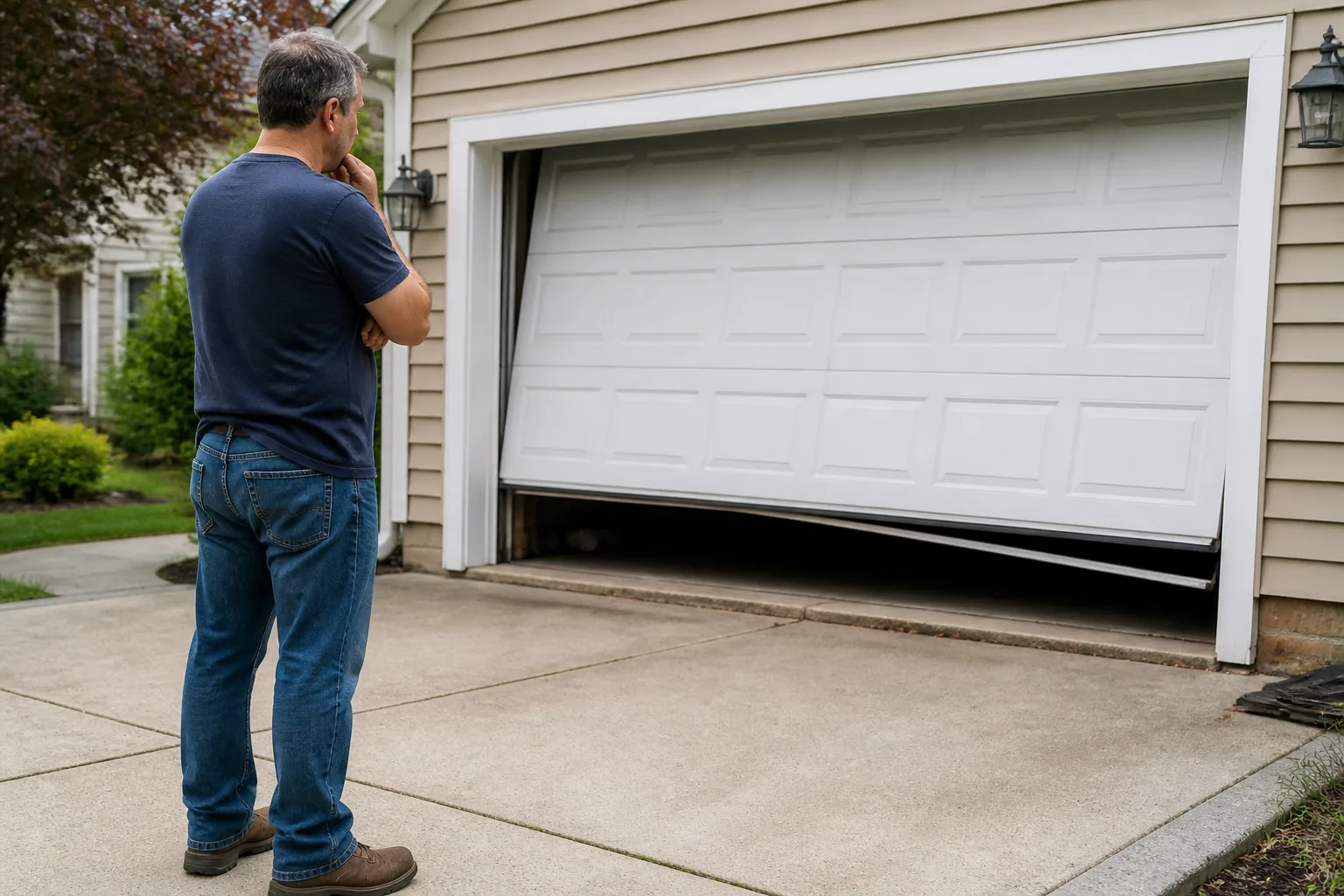
- Door hanging off the track with panels at risk of falling. That’s a safety emergency, not a convenience one.
Urgent but can wait until morning
- Opener runs but the door doesn’t move. Likely a trolley or gear issue, and the door is still down and secure.
- Door reverses without warning. A sensor or limit-setting issue on the opener; the door still closes and the home stays locked.
- Noisy opener, grinding or squealing. Nearing a service need, but the door is functioning and secure.
- A remote or keypad that stopped working. Annoying, not an emergency.
If you’re unsure which bucket you’re in, describe it on the phone and we’ll tell you honestly whether it’s a tonight call or a tomorrow call.
When Should a Vineland Homeowner Call a Pro for Garage Door Repair?
Call a pro whenever the door involves springs, cables, torsion hardware, or anything under counterbalance tension, and whenever a panel or track is damaged enough to affect the door’s travel. Those are the jobs where a wrong move can cause injury, and where a specialist with the right tooling gets it right the first time. Our technicians have up to 11 years of experience across the brands on your door, and spring work is core to what we do rather than a side job.
A few signs it’s time for garage door repair rather than a wait-and-see:
- The door is noticeably harder to lift by hand than it used to be.
- You hear a loud snap from the door followed by the door feeling extremely heavy.
- A cable is hanging loose or frayed on either side.
- The door travels crookedly or a roller has jumped the track.
- The opener strains, grinds, or won’t lift the door at all.
If your opener is the failing part, that’s a separate specialty, and our garage door opener repair handles motors, sensors, and trolleys. We stay strictly inside garage doors, which is why we can diagnose a Raynor or LiftMaster issue quickly instead of looking it up while you wait.
Related services in Vineland
Everything we do lives under one specialty: general repair, opener repair, spring repair, new door installation, and emergency service. You can see the full picture on our Garage Door Repair Vineland page. If the emergency reveals a door that’s past saving, we handle garage door repair and replacement both, so you won’t need a second company.
The Bottom Line
Secure the opening first, then call. The manual lock on your door, engaged into the track, closes off the real security exposure in under two minutes and buys you a calm phone call. Leave the springs, cables, and counterbalance to a specialist; that’s where the injuries happen and where the wrong move turns a repair into a replacement. Have the width, panel count, and opener model ready, and sort your situation honestly into emergency or can-wait, so the right job gets the right response.
If you’re in Vineland and need help, Garage Door Repair Vineland offers free estimates. Call (844) 443-4769. We answer 24/7. Fast dispatch from 7am to 7pm, Sunday through Friday. The price is quoted and agreed before any work starts, so there’s no surprise when the invoice comes.
Frequently Asked Questions
Most emergency repairs fall into a typical range depending on what failed, but the exact price is set per job by a written estimate before any work begins. A single torsion spring replacement is commonly quoted in the low-to-mid two hundreds, a matched pair roughly double that, and opener repairs vary by the part. You’ll get the number in writing and agree to it first. Call (844) 443-4769 for a free estimate.
Yes for most urgent repair calls. We answer 24/7, and fast dispatch runs 7am to 7pm, Sunday through Friday. A call outside dispatch hours is booked into the next opening, Sunday through Friday, 7am to 7pm. Call (844) 443-4769 and we’ll confirm a time.
No. The written estimate sets the price, and we quote and agree on it before any work starts. If we find a second issue, we tell you and get your approval before doing it, so the invoice matches what you agreed to. Call (844) 443-4769 for a free estimate.
The local professionals we connect you with are licensed and insured as their state requires, and they specialize in garage doors rather than general home repair. Our technicians have up to 11 years of experience. Call (844) 443-4769 to book a free estimate.
Written by the team at Garage Door Repair Vineland.
Need Garage Door Help?
Call Garage Door Repair Vineland - the local pro we connect you with is licensed and insured, here with fast help in Vineland.
(844) 443-4769